SMW Truth Bomb: Why HVAC Ductwork Sizing Matters
Buying a new air conditioner is not like buying a box of cereal at the grocery store. You can pour cereal into any cheap bowl and get the same result, but an HVAC system doesn’t work that way. The AC unit on your roof is just the heart; proper HVAC ductwork sizing represents the lungs of your home.
Too many homeowners try buying AC units online or hiring the cheapest guy in town, completely ignoring the ductwork because they don't want to be "upsold." It is a massive injustice when an installer slaps a brand-new, high-end system on your house without measuring your home's static pressure or checking your HVAC ductwork sizing first. If a contractor doesn't know how your old system breathed, your new Phoenix AC replacement is doomed from day one.
Old Motors Forgave Bad Ductwork. New Motors Don't.
To understand why ductwork sizing is suddenly so critical, you have to look at how the technology has changed. Back in the day, old AC units ran on basic PSC capacitor motors. If your home's improperly designed ductwork was undersized and restrictive, those old blower motors would just shrug, slow down, and push less air. You lost some comfort in the back bedrooms, but the unit survived.
Modern technology doesn't operate that way. Everything has shifted to high-tech Constant Torque and Variable Speed (ECM) motors. These modern blowers are specifically designed to deliver a constant, precise volume of airflow (CFM) into the home, regardless of the resistance they face.
When you force a modern ECM blower to push air through tiny, restrictive ductwork, it goes to war. The motor will spin faster and harder, doing absolutely everything it can to force that volume of air through the restriction. This drastically increases your wattage consumption and completely kills the high efficiency you just paid top dollar for. That motor burns itself out trying to breathe, virtually guaranteeing you will be calling for a major Chandler air conditioning repair in under five years.
The High-Pressure Refrigerant Shift
It isn’t just the motors that have changed; it’s the actual blood of the system. Everyone still calls it "Freon," but the industry has rapidly shifted away from the old R-22 refrigerant to R-410A, and now we are transitioning to R-454B and R-32. These modern refrigerants operate at significantly higher pressures, making proper airflow more critical than ever before.
This becomes a massive danger if you run a heat pump in heating mode during the winter. With the old R-22, the heating pressure on your indoor coil might have sat around a manageable 200 to 250 PSI. With modern high-pressure refrigerants, that pressure can easily spike over 400 PSI.
If your ductwork is undersized and restricting airflow, the heat cannot effectively leave that indoor coil. The pressure skyrockets, causing your compressor to violently overwork and repeatedly trip out on high-pressure limits. It all directly relates to the life of your unit. You simply cannot put a high-pressure modern system on choked-out ductwork and expect it to survive.
The "3-Month" Filter Trap and Better Registers
Sometimes the restriction isn't just the ductwork; it is the homeowner. We constantly see people buying those expensive, 1-inch pleated "3-month" filters at the hardware store. Because those filters are so tightly woven to catch dust, they act like a brick wall on your return ductwork. If you absolutely insist on using those heavy, restrictive filters, you must have a contractor add extra return ductwork and strictly check your static pressure to compensate.
The same airflow restriction happens on the supply side when you walk around, closing bedroom registers to try to "save money." Shutting those vents spikes the static pressure inside the ductwork. Conversely, did you know that simply upgrading your supply registers can actually help? Changing out cheap, stamped-metal builder grilles for high-quality OBD (Opposed Blade Damper) bar-style registers can significantly improve your home's airflow comfort and efficiency without putting extra strain on the motor.
The Sound of Wasted Money: The Return Sizing Cheat Sheet
We walk into homes across the East Valley HVAC market all the time and immediately hear the return vents whistling. That noise isn't normal, and there is absolutely no reason you should hear air running through your filter returns. It is the sound of high static pressure, wasted energy, and violent wear and tear on your equipment. When your returns are undersized, your system is trying to run a marathon while breathing through a cocktail straw.
To give you an idea of the massive airflow your system actually needs, I want to make this explicitly clear. Here is the exact SMW math from our duct sizing cheat sheet for proper return sizing on larger systems:
For a 4-Ton System (1600 CFM):
Minimum Setup:
Best Airflow Setup:
For a 5-Ton System (2000 CFM):
Minimum Setup:
must
Best Airflow Setup:
If your home’s framing won't let us run a massive 20-inch return duct, we can't just choke the system. We have to get creative by increasing the size of the smaller grilles. For example, we might run an 18-inch duct paired with another larger grille on a different wall so the combined square footage equals the exact airflow your system needs.
Jump Ducts and Real-Time Air Balancing
A lot of contractors try to fix airflow problems by cutting "jump ducts" between rooms to relieve pressure. If you have a room that needs better airflow, a jump duct is a poor workaround. You are pulling conditioned air out of a room, running it through a jump duct in a hot attic, and just dropping it back into a hallway.
To get proper, balanced airflow, you need to take that air back to the source. True Tempe HVAC air balancing means hard-piping a dedicated return from that hot room directly back to the main unit. We use a calibrated flow hood to get a real-time baseline measurement of the air actually coming out of your registers. The required airflow for a master bedroom changes based on the direction the house faces and the size of the west-facing windows. A room baking in the afternoon sun requires a completely different ductwork strategy than a shaded guest room.
The "Spider Web" Mistake, Friction, and Heat Gain
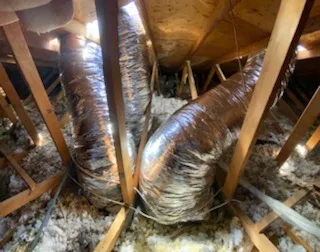
Now, let's talk about the supply ducts pushing cold air to those rooms. When evaluating your HVAC ductwork sizing, a massive mistake builders make is running long stretches of small flex duct all the way across the house from a central box. This is called a "spider" system, and the physics behind it are terrible.
Small-diameter ducts have a massive surface area compared to the amount of air inside them. When you force air through 40 feet of small tubing, the friction spikes, and your blower motor has to work twice as hard. Worse, the cold air moves too slowly through a hot tube, spending too much time where it is liable to pick up heat gain. By the time that air travels across a 160-degree attic, it absorbs radiant heat and might blow out of your master bedroom register 2 to 8 degrees warmer than when it left the unit.
The scientifically proven way to solve this is the "Trunk-and-Branch" method. Instead of a dozen long spider webs, we run a larger, properly sized central "trunk line" down the length of the house. Then, we use very short, targeted flex duct "take-offs" for the final connection to the individual rooms. This keeps the air velocity high and drastically reduces the surface area exposed to the attic heat.
The Gold Standard: Double-Insulated Plenums and Metal Wyes
Even the mixing boxes (or plenums) that connect your ductwork matter. A residential mixing box must be sized specifically to your system’s tonnage—generally requiring 400 CFM per ton of cooling. If a lazy installer makes the box too small, it creates high static pressure and loud air noise. If they make it too big, the air velocity drops and dust settles inside the ductwork.
Many cheap installations use fiberglass "ductboard" for these boxes, which degrades quickly in the brutal Arizona heat. The factual gold standard is using heavy-gauge sheet metal boxes lined with a 1-inch black antimicrobial liner on the inside for noise reduction and a baseline thermal barrier. But we don't stop there. In a 160-degree attic, we wrap the outside of that metal box with heavy foil-faced insulation. This "double insulation" prevents the metal from absorbing and holding attic heat.
When it comes to splitting the air, we strictly use rigid metal Wye (Y-shaped) fittings for maximum efficiency. A metal Wye maintains a perfectly smooth internal shape to prevent air restriction, and because it has very little surface area, it doesn't absorb much heat. We then pull the flex duct insulation completely over the top of the metal, creating a seamless thermal barrier.
Proper Ahwatukee ductwork replacement using these specific upgrades—properly sized boxes, double insulation, and rigid metal transitions—is the absolute most effective way to solve airflow problems and lower your energy bills. Don't let a bad contractor put new equipment on broken lungs. Get the ductwork right the first time.
Scott Wetter - Owner, SMW Refrigeration & Heating LLC ROC 172364 | ROC 337415 Family Owned & Operated since 1964 Serving Phoenix, Tempe, Ahwatukee, and Chandler.
Need HVAC Service?
Call SMW Refrigeration & Heating for expert service throughout Maricopa County.
Call (602) 992-1930Related service
Ductwork & duct sealing services →